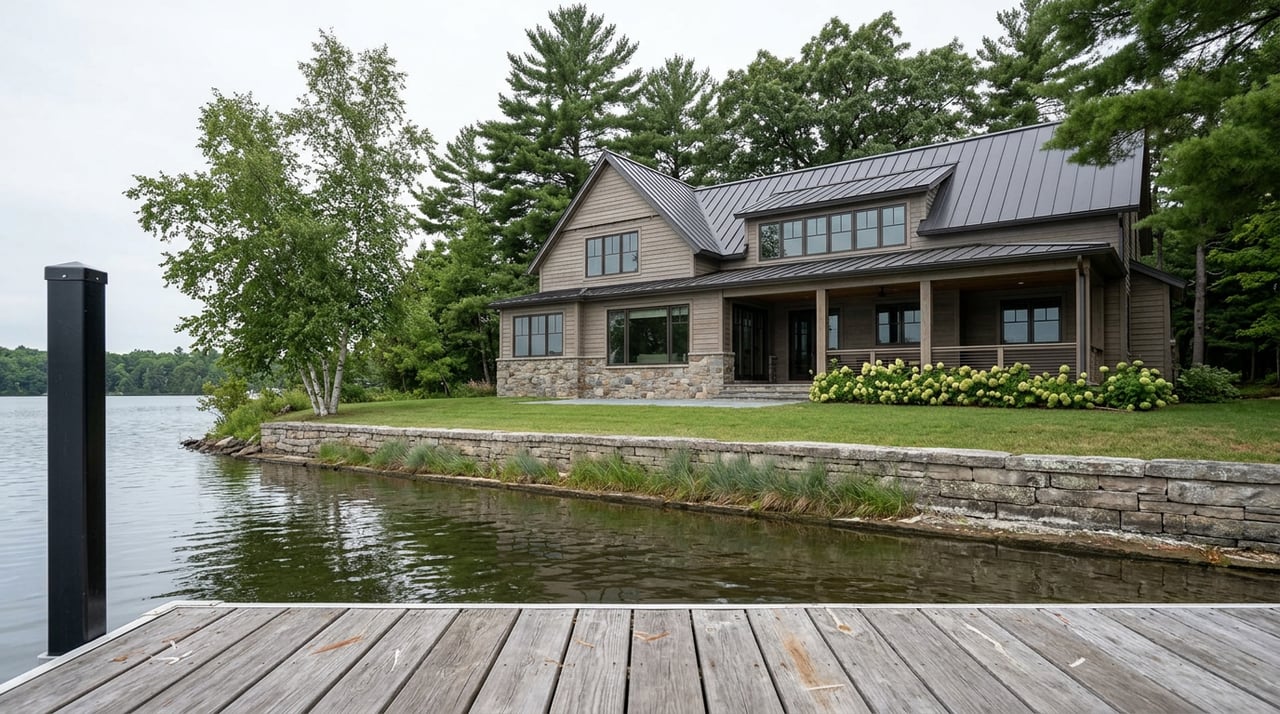
Buying a Home on Lake Wawasee: What to Check Before You Buy
September 3, 2026
September 3, 2026
The dock is already built. The seawall looks solid. The listing calls it "lakefront." Before you get attached to any of that, ask yourself whether you'd be allowed to touch it once you own it.
That question surprises a lot of first-time lake buyers around Syracuse, and it should. Indiana's largest natural lake pulls people in with wide water views and a slower pace, but the paperwork underneath that view runs through a state agency, not the seller. Meanwhile, the one system almost every buyer assumes gets checked automatically, the septic tank buried somewhere in the yard, often doesn't get checked at all unless someone asks. Those two facts, pulling in opposite directions, explain more about a Lake Wawasee closing than any median price on a portal ever will.
Indiana's Lake Preservation Act, passed in 1947, treats the shoreline of a public freshwater lake as a public resource, not a private extension of the lot line. Practically, that means any permanent structure at or below the average normal shoreline of Lake Wawasee, a seawall, a dredged boat well, a permanent pier, needs written approval from the DNR Division of Water before construction starts. A homeowner can't simply rebuild a failing seawall the way they'd replace a fence.
There's a narrower path for temporary piers. The DNR's general license exempts a pier from full permitting if it meets a specific set of conditions, starting with being easily removable each season. Even then, length matters, and it isn't the same number lake to lake. Clear Lake in Steuben County gets a 250-foot allowance under the general license. Bass Lake and parts of Lake of the Woods get 300 feet. Near Wawasee, DNR testimony in a past enforcement case put the practical ceiling closer to 175 feet, a figure the district's own commanders settled on because high-speed boating is authorized starting 200 feet from shore. None of this is printed on a listing sheet, and none of it is optional just because the pier has been sitting there since the previous owner bought the place.
These disputes aren't hypothetical. In Bath v. Courts, a case out of Nyona Lake, neighbors ended up in the Indiana Court of Appeals over a pier extension and platform that encroached on the property next door. The lesson for a buyer isn't the legal outcome. It's that a structure looking permanent and uncontested for years doesn't mean it was ever actually permitted, and DNR enforcement, or a neighbor's complaint, can surface that gap after you own the property.
Before you write an offer on anything with a pier, boat well, or seawall, ask whether it was permitted and ask to see the paperwork. A missing permit doesn't necessarily kill a deal, but it changes what you're buying: a structure you can maintain as-is versus one you may need to bring into compliance yourself.
The word "waterfront" gets used loosely around Wawasee, and it's covering three genuinely different situations.
| Access Type | What You're Actually Buying | Boating Reality |
|---|---|---|
| Open-water frontage | Direct lot line on the open lake | Widest views, most boat storage flexibility, highest price point |
| Channel-front | Lot on a connecting channel | Protected dockage, short ride to open water, generally more attainable pricing |
| Deeded or association access | Shared pier rights, no private shoreline | A place to keep a boat without owning the shore itself |
These aren't marketing categories. They're different real estate products with different permitting exposure, different insurance conversations, and different resale pools. A channel-front buyer and an open-water buyer are not shopping the same market even when both listings say "Lake Wawasee."
That distinction shows up in the numbers. As of early July 2026, homes listed on Lake Wawasee carried a median list price around $819,000, with average pricing near $536 per square foot. Homes listed on the connected Syracuse Lake, reachable by boat through the same channel, carried a higher median list price near $899,000 as of late May 2026, at roughly $578 per square foot. These are two bodies of water joined by a channel, and their medians still sit about $80,000 apart.
Compare either number to the town-wide median home price for Syracuse, which portals put around $350,000. That figure includes everything in town, not just the water. A buyer who searches "Syracuse home prices" and anchors on that number, then walks into a Lake Wawasee showing expecting something close to it, is going to be recalibrating fast. The town median and the lake median aren't measuring the same market, and the gap between them is the real story hiding behind any single "average home price" headline.
Here's the part that catches people off guard in the opposite direction. While DNR tightly controls what happens at the shoreline, Indiana has no statewide law requiring a septic inspection before a home with an existing system changes hands. There's no automatic checkpoint the way there is for a pier extension.
Kosciusko County's Health Department does require permits for new septic and well installations, and for any repair or replacement work on an existing system. What that oversight doesn't cover is a system that's already installed, still functioning, and simply changing owners. Unless your lender requires an inspection, which FHA and VA loans typically do, or unless you write one into your purchase contract yourself, a septic system on a Wawasee property can pass from seller to buyer without anyone independently confirming its condition.
That's worth sitting with for a second. The same property where DNR wants documentation before you extend a pier by a few feet can change hands with a decades-old septic system that nobody has looked at since it was installed. A well is the same story: it exists on the county's radar when it's drilled or repaired, not necessarily when the house sells.
If you're financing with a loan type that doesn't require it, don't assume "no news" means "good system." Ask for the septic's age, ask when it was last pumped and by whom, and consider making an independent inspection a contingency regardless of what your loan program technically requires.
None of these questions are things a seller is obligated to volunteer. They're things a buyer has to ask, and the answers shape what you're actually paying for far more than square footage does.
Do I need a state permit to build a new pier on Lake Wawasee? If the pier meets the DNR's general license criteria for a temporary, easily removable structure, you may not need a separate permit. A permanent pier, a seawall, or any dredging still requires approval from the DNR Division of Water under the Lake Preservation Act.
Is a septic inspection legally required to sell a home in Indiana? No. There's no statewide law mandating it. Whether an inspection happens usually comes down to your loan type or whether you negotiate one into your contract.
Are Lake Wawasee and Syracuse Lake the same real estate market? They're physically connected by a channel, but their median list prices have run meaningfully different in 2026. Treat them as related but distinct markets rather than interchangeable ones.
Buying on the water around Syracuse rewards patience more than it rewards speed. The house is the easy part to evaluate. The permitting history, the access type, and the systems nobody's required to check are the parts that take a local eye. If you're weighing a purchase on Lake Wawasee, Syracuse Lake, or anywhere else in Northeast Indiana, First Response Realty has spent years walking buyers through exactly these questions before they become expensive surprises. Contact us when you're ready to look at the water with someone who already knows what to ask.
Stay up to date on the latest real estate trends.
We pride ourselves in providing personalized solutions that bring our clients closer to their dream properties and enhance their long-term wealth.
GET IN TOUCH WITH OUR TEAM TO LEARN MORE
FIRST RESPONSE REALTY
11625 COLDWATER RD FORT WAYNE, IN 46845